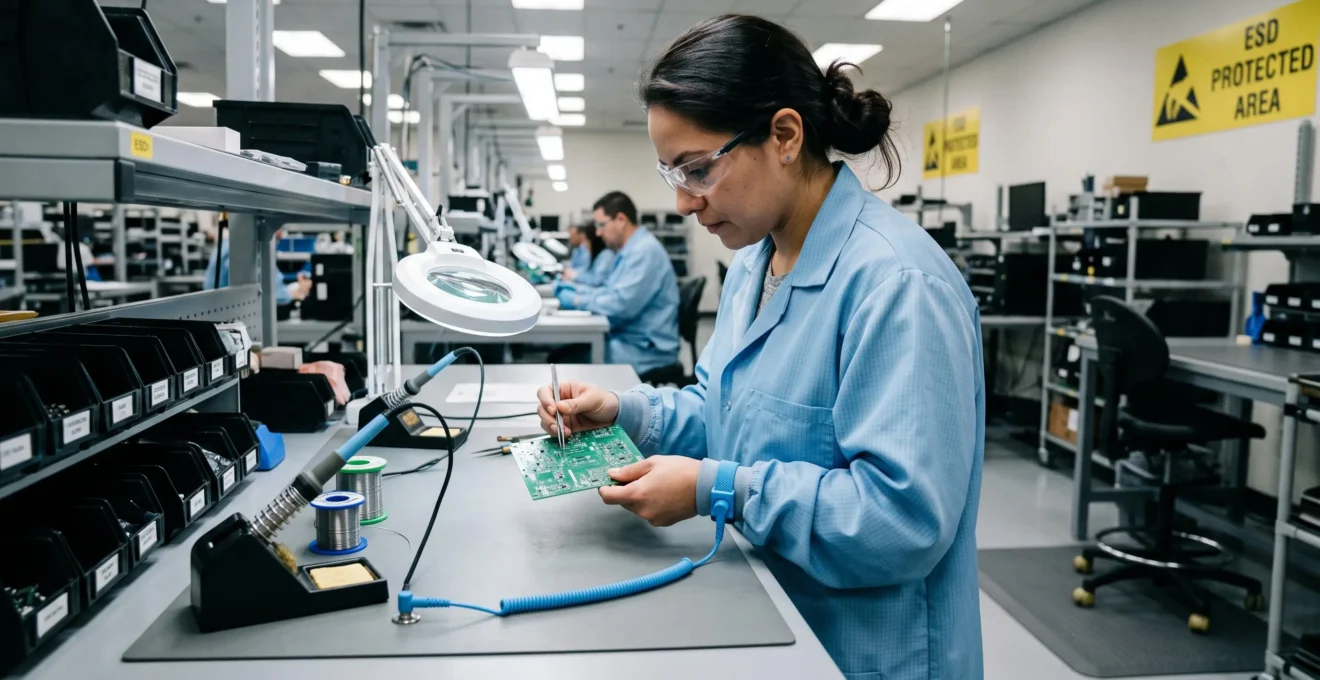
Setting up a new ESD Protected Area usually starts the same way: a vendor sends a twenty-page catalog, an online resource lists forty “essential” items, and the equipment budget has a hard ceiling. The reality documented by the industry is narrower. Compliance under ANSI/ESD S20.20-2021 rests on a small number of well-specified fundamentals, verified systematically, rather than on an exhaustive shopping list.
This article gives you a prioritized equipment list for your EPA zone: what is essential, what is recommended, what can wait, and the exact specifications to check before purchasing. It also covers verification protocols, because compliant equipment without documented testing fails audits just as surely as missing equipment.
This guide provides general information on ESD protective equipment based on published standards and industry sources. It does not replace the ANSI/ESD S20.20-2021 standard itself, your internal quality procedures, or advice from a qualified ESD control engineer. Requirements can vary depending on your products, processes, and customer contracts.
Direct answer: For most electronics assembly EPA zones, the essential equipment reduces to three or four categories: a compliant personal grounding system (wrist straps in the 1–10 MΩ range, or ESD footwear below 35 MΩ), static dissipative garments and work surfaces, and the test equipment needed to verify all of it daily. Everything else can typically be added progressively as your risk assessment dictates.
- What defines an EPA zone and why ESD protection is non-negotiable
- The three-layer foundation of ESD personal protection
- Essential grounding equipment: wrist straps and footwear specifications
- Which ESD garments and clothing are mandatory in your EPA zone?
- Complementary EPA equipment: mats, gloves, and workstation accessories
- How to verify and maintain ESD protective equipment effectiveness
- Four critical mistakes when building your ESD equipment checklist
What defines an EPA zone and why ESD protection is non-negotiable
An EPA zone (ESD Protected Area) is a designated space equipped and managed so that sensitive electronic components can be handled without exposure to damaging electrostatic discharge. The governing framework in the United States is the ANSI/ESD S20.20-2021 standard, which applies to organizations handling parts susceptible to damage from discharges of 100 volts or greater (Human Body Model) and 200 volts or greater (Charged Device Model). Isolated conductors within the zone must be kept below 35 volts.
Those thresholds matter because modern components—CMOS devices, microprocessors, and similar sensitive parts—sit precisely in the voltage range that everyday human contact and material friction can generate. A charge you never feel can still destroy a die. That is also why handling procedures matter as much as hardware; even a well-equipped zone fails if operators introduce charged items, a theme covered in depth in this guide to common mistakes with electronic components.
$0.5–5billion/year
According to the EOS/ESD Association, widely cited industry estimates place ESD-related losses in the electronics industry between half a billion and five billion dollars annually, though the original source of this figure is no longer traceable. Some large companies have reported that about 25% of identified component failures were attributable to ESD.
The financial argument is difficult to dismiss. In a typical assembly scenario, an undetected ESD event during handling damages a microprocessor internally; the board passes intermediate checks, then fails at final test, triggering rework, schedule slips, and—worst case—a field failure. Because latent ESD damage is often invisible until late in the process, the cost multiplies at each stage. Framed this way, an equipment budget is not a compliance expense; it is loss prevention with a measurable payoff, which is a conversation that tends to go better with operations leadership than “the standard requires it.”
For resources on ESD safety equipment and services, specialized suppliers structure their offerings around these standard requirements rather than generic catalog-upselling, which helps when comparing vendor claims.
The three-layer foundation of ESD personal protection
Every piece of equipment in a compliant EPA zone belongs to one of three functional layers. This framework is the fastest way to decide whether an item is essential: if it fills a gap in a layer you have not covered, it deserves budget priority; if it duplicates a layer you have already covered, it can usually wait.
- Layer 1 – Personal grounding: a continuous physical path from the operator’s skin to a common point ground, via a wrist strap or ESD footwear. Without this path, charges generated by movement accumulate on the person and discharge into the first sensitive part they touch.
- Layer 2 – Static dissipation: dissipative materials (garments, work surface mats, floor mats) that prevent static accumulation on surfaces and clothing, and bleed charges slowly and safely to ground.
- Layer 3 – Contamination control: physical barriers such as gloves, finger cots, and head covers that protect parts from skin oils, salts, and particulates—not strictly an ESD function, but inseparable from it in practice for sensitive assemblies.
The Three-Layer ESD Protection System at a Glance : Personal grounding (wrist strap or footwear → common point ground) moves charge off the person. Static dissipation (garments, mats, surfaces in the 10⁶–10⁹ ohms range) prevents accumulation on materials. Contamination control (gloves, cots, head covers) protects the product from particulate and ionic contamination. A gap in any layer weakens the whole system—like a chain, the ESD program performs at the level of its weakest link.
The interdependence is the part vendors rarely explain. An operator wearing a perfectly functional wrist strap over a synthetic sweater that generates charge at the cuffs still poses a threat to exposed components: the grounded body drains through the strap, but the charged garment induces charges onto parts in contact with it. The layers work as a system, and audits examine them as a system.
Essential grounding equipment: wrist straps and footwear specifications
Personal grounding is the non-negotiable core of your equipment budget. The two accepted solutions—wrist straps and ESD footwear—serve different workstation contexts, and the choice between them is mostly operational, not technical.
Wrist strap system: the 1–10 MΩ rule
A seated workstation requires a wrist strap system: an adjustable band worn snugly against bare skin, a coiled cord, and a connection to a common point ground. The complete system must fall within the 1–10 MΩ resistance range. The logic is symmetrical: resistance below that range approaches an electrical safety hazard for the wearer, while resistance above it drains charges too slowly to protect sensitive parts. Wrist strap systems are qualified under ANSI/ESD S1.1-2021 and verified in operation using the methods of ESD TR53-01-18, with the grounding/bonding system itself covered by ANSI/ESD S6.1-2019.
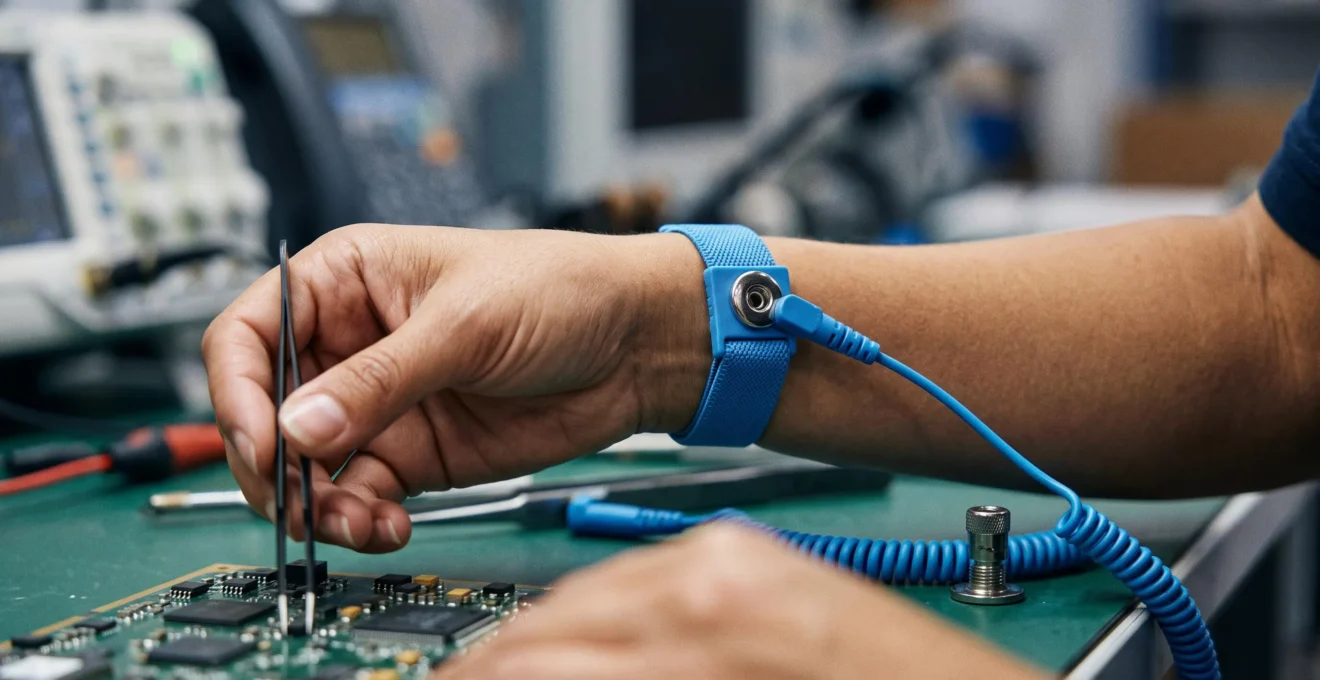
Installation errors silently defeat even certified hardware. A wrist strap cord clipped to a painted, non-conductive surface or to ungrounded equipment provides zero protection while appearing compliant to a passing glance. Every strap must terminate at a verified common point ground bonded to earth—not to a bench leg, and not to “whatever was convenient.”
ESD footwear and heel grounders: the mobile operator solution
For operators who move—material handlers, inspectors, anyone working across multiple stations—wrist straps are impractical. The alternative is ESD footwear, with a heel-to-toe resistance below 35 MΩ, used on appropriate ESD flooring. Note an important evolution of the standard: since the 2014 revision, footwear/flooring systems must pass both a resistance test and a walking body-voltage test, because resistance alone proved insufficient—a person walking can generate body voltages above 100 volts even at system resistance levels that once qualified on resistance alone.
Heel grounders offer a budget-friendly middle path: they strap onto regular shoes instead of requiring dedicated ESD footwear purchases for every operator. Their limitations are real, though. They require conductive flooring to function, they depend on correct daily wearing (contact tab inside the shoe, against skin), and they are less reliable than dedicated footwear when worn carelessly. For a cost comparison of the three grounding options, the decision points are summarized below.
The following table compares the three main personal grounding options on the criteria that actually drive purchasing decisions. Costs are described qualitatively, since prices vary significantly by supplier and volume.
| Criterion | Wrist strap system | ESD footwear | Heel grounders |
|---|---|---|---|
| Resistance requirement | 1–10 MΩ system | < 35 MΩ heel-to-toe | < 35 MΩ (with flooring) |
| Best suited for | Seated, fixed workstations | Mobile operators, standing work | Budget-limited mobile operators |
| Key dependency | Common point ground at each station | ESD flooring throughout the zone | ESD flooring + correct daily wearing |
| Test equipment needed | Wrist strap tester (daily) | Footwear tester (per standard protocol) | Footwear tester (per standard protocol) |
| Relative cost per operator | Low | Highest | Low |
| Relative reliability | High when tested daily | High | Moderate—depends on wearer discipline |
Which ESD garments and clothing are mandatory in your EPA zone?
ESD garments are where vendor upselling is most aggressive, so the distinction between mandatory and optional deserves a risk-based answer rather than a flat list.
The baseline item for most EPA zones is the ESD smock or lab coat, with a surface resistance in the 10⁶ to 10⁹ ohms range. Its function is to contain the static generated by operators’ personal clothing, which cannot be controlled. For a standard PCB assembly zone handling sensitive components, smocks for all operators who enter the zone are generally treated as mandatory, and auditors expect them.
What escalates beyond the smock depends on your product, not on the vendor’s catalog:
- Coveralls: justified in cleanroom-class environments or when contamination sensitivity is extreme; a significant cost step up that a standard assembly zone rarely needs.
- Head covers and antistatic gloves: required when handling bare die or wafers, or when particulate contamination is critical; typically optional for standard PCB assembly with automated placement.
- Personal clothing rules: wool and charge-generating synthetics should be discouraged under garments; cotton is a reasonable low-cost fallback where smocks are worn.
A practical decision rule: if operators handle exposed sensitive components directly with their hands, gloves and finger cots move from optional to expected, because the contamination and moisture risk compounds the ESD risk. If components stay in carriers or on automated lines, gloves become a process choice rather than a compliance requirement.
Complementary EPA equipment: mats, gloves, and workstation accessories
Beyond personal grounding and garments, a handful of supporting items complete the system. The priority question is which of them block certification if missing—and the answer is: work surfaces first, everything else by degree.
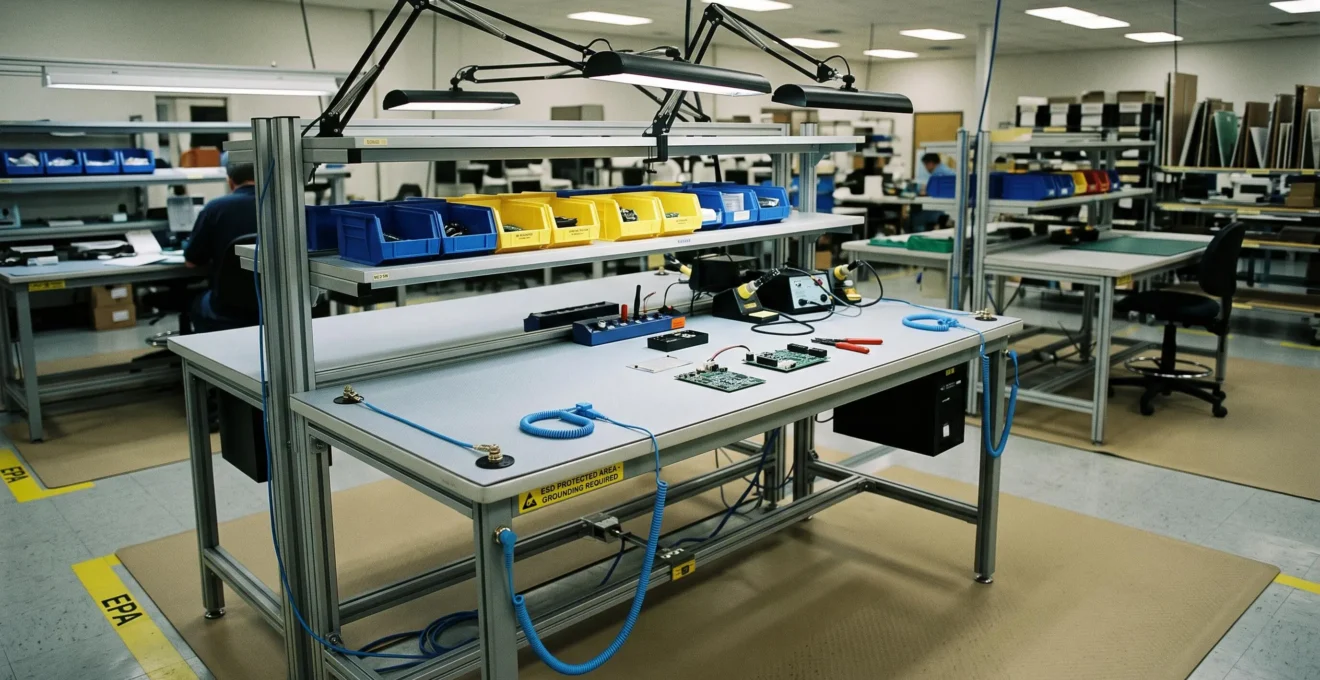
ESD work surface mats provide a dissipative surface (typically within the 10⁶–10⁹ ohms class) that bleeds charges from parts and tools to the common point ground. They are standard in virtually every EPA zone because components rest on them constantly. Gloves and finger cots follow the contamination logic from the previous section. Ionizers address a specific gap: when process-required insulators or unavoidable isolated conductors are present, air ionization neutralizes charges that grounding cannot reach—necessary in some zones, a major expense unnecessary in many. ESD-safe tools and containers prevent re-introducing charge through everyday handling items.
- Work surface mats with common point ground connectionsPresent at every handling station; without them, parts rest on uncontrolled surfaces. Highest priority among complementary items.
- Floor matting at standing/mobile stationsRequired wherever footwear-based grounding is the chosen method, since heel grounders and ESD shoes depend on it to function.
- Finger cots or conductive gloves for direct part handlingEssential when operators touch exposed sensitive components; optional where parts stay in carriers.
- ESD-safe storage bins, carriers, and containersPrevent charged transport of parts between stations; scale with your material flow complexity.
- IonizersOnly when insulative materials are process-required or grounding is impractical at a station. Highest cost item on this list—justify before buying, not after.
This sequencing is what makes a phased budget viable. With a fixed equipment envelope, the grounding layer plus mats and garments consumes most of it, and the remaining items can follow in a second phase without leaving a compliance gap in the interim—provided the verification tools from the next section are included from day one.
How to verify and maintain ESD protective equipment effectiveness
Compliance under ANSI/ESD S20.20-2021 is a verification program, not a purchase order. Auditors check two things: that your equipment meets specifications, and that you can prove it has been tested. The second is where otherwise solid programs fail.
- Plug in and testOperator inserts the wrist strap cord into a wrist strap tester and presses the test plate, completing the circuit through the band, cord, and skin contact.
- Read the pass/fail indicationThe tester checks the complete system against the 1–10 MΩ thresholds: below range and above range both fail, for the electrical safety and dissipation reasons covered earlier.
- Log or tag the resultA simple log—date, operator, pass/fail, action taken on failure—is the documentation auditors will ask for. Test before each shift is the common practice; the standard’s verification methods are defined in ESD TR53-01-18.
- Quarantine and replace on failureA failed strap comes out of service immediately. Replacement cords and bands are low-cost consumables; budget them as recurring items from the start.
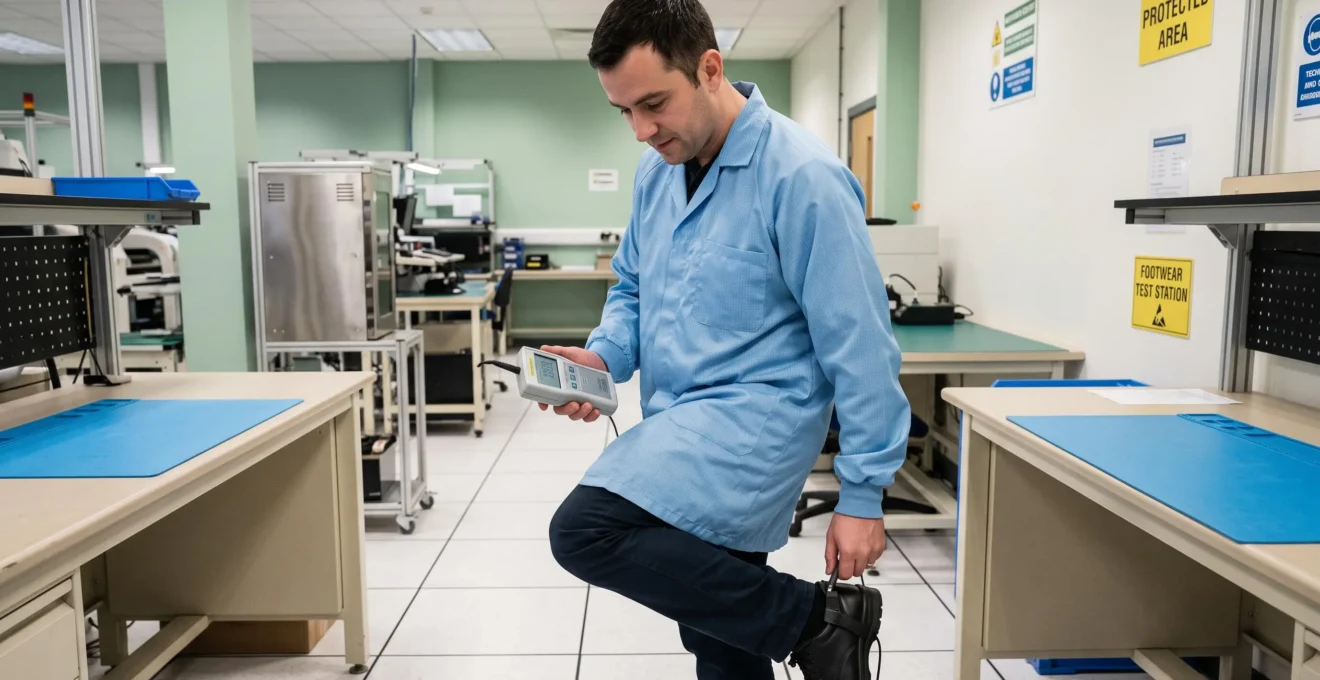
Footwear follows the same logic at a lower frequency, using a footwear tester with the operator standing on the plate: one foot at a time, checking against the sub-35 MΩ requirement. Because resistance alone no longer guarantees compliance, periodic walking body-voltage testing also belongs in the program since the 2014 revision of the standard. Visual inspections round out the routine at nearly zero cost: frayed cords, cracked mats, torn garment cuffs, and heel grounder tabs worn smooth are all replacement triggers that show up before a formal test catches them.
Compliance Gap: ESD Equipment Without Verification Tools : The most common budgeting error is buying all protective equipment and no test equipment. A wrist strap tester at each zone entrance and a resistance meter for periodic checks of footwear, mats, and garments are not accessories—they are the instruments that make your compliance demonstrable. Leaving them out of the initial budget is how facilities discover, during an audit, that six months of wrist strap use cannot be documented at all.
Maintenance budgeting should assume consumables, not one-time purchases: wrist strap cords and bands wear with daily use, garments degrade with laundering, and mats eventually crack. Building a recurring line item for replacements into year one avoids the year-two scenario where worn equipment quietly drifts out of spec between tests.
Four critical mistakes when building your ESD equipment checklist
Most EPA zone failures trace back to a handful of avoidable errors. Each of the following costs far less to prevent than to correct after an audit finding.
- Skipping the verification equipment. A fully specified zone with no wrist strap testers or resistance meter cannot demonstrate compliance. Auditors ask for test logs first, not equipment receipts.
- Mixing resistance classes without checking the path to ground. A low-resistance wrist strap connected through a high-resistance dissipative mat at an unsuitable common point can leave an ineffective path to ground. Every element in the chain should be evaluated as part of one continuous circuit to the common point ground, not as isolated compliant items.
- Underestimating operator training. Correctly specified equipment worn incorrectly—strap over a sleeve, heel grounder tab tucked outside the shoe—delivers the appearance of protection without the function. A short hands-on session at rollout, repeated for new hires, protects the entire investment.
- Treating documentation as an afterthought. Missing or incomplete test logs constitute an audit failure even when every piece of hardware is in spec. The log format can be simple, but it must exist, be current, and cover the period the auditor samples.
A fifth mistake deserves mention because it masquerades as savings: buying on price alone without checking the resistance specification printed in the product data. Out-of-spec equipment ultimately costs a replacement purchase plus the audit risk carried in the meantime—false economy in its purest form.
Practical case
Consider a quality team that equips a new assembly zone with equipment fully compliant with the specifications, but fails to establish the daily wrist strap test log. Six months later, the auditor finds no documented verification at all: operational compliance is real but undemonstrable, and the finding amounts to an audit failure.
The path from this list to a working program is short. Cover the three layers in order—grounding, dissipation, contamination—insist on the numeric specifications in this article during purchasing, and put the daily verification routine in place the same week the equipment arrives. The framework scales: when you expand the zone or open a new line, the same three-layer logic tells you what the new area needs and what it does not. And because ESD control ultimately protects the components themselves, deepening your team’s component-handling knowledge with this comprehensive guide to circuit design is a natural next step for building durable expertise beyond equipment alone.
Do I really need all this ESD equipment or is it vendor upselling?
The mandatory core is narrow: a compliant personal grounding system, dissipative garments and surfaces, and the test equipment to verify them. Items like ionizers, coveralls, and full cleanroom garments are only justified by specific product or contamination requirements. If a vendor cannot link a recommended item to a gap in one of the three protection layers, treat it as optional.
How often should ESD wrist straps be tested?
The common practice is a tester check before each shift, using a wrist strap tester that validates the complete system against the 1–10 MΩ range. Verification methods are defined in ESD TR53-01-18, and results should be logged for audit documentation.
Can I use heel grounders instead of buying ESD shoes for everyone?
Yes, provided the zone has appropriate ESD flooring and operators wear them correctly with the conductive tab against skin inside the shoe. Heel grounders must meet the same sub-35 MΩ requirement as ESD footwear, and both require resistance and walking tests since the 2014 revision of the standard.
What ESD equipment will auditors actually check?
Auditors verify both hardware and process: wrist strap resistance records, footwear test documentation, garment and mat specifications, common point ground integrity, and written procedures. A fully compliant zone without test logs is an audit failure, which is why verification tools belong in the initial budget.
The equipment list that passes an ESD audit is shorter than most catalogs suggest: grounding specified in megohms, dissipative surfaces and garments specified in ohms, and a daily habit of proving both still work. Start there, document everything, and add the rest only when your products demand it.